
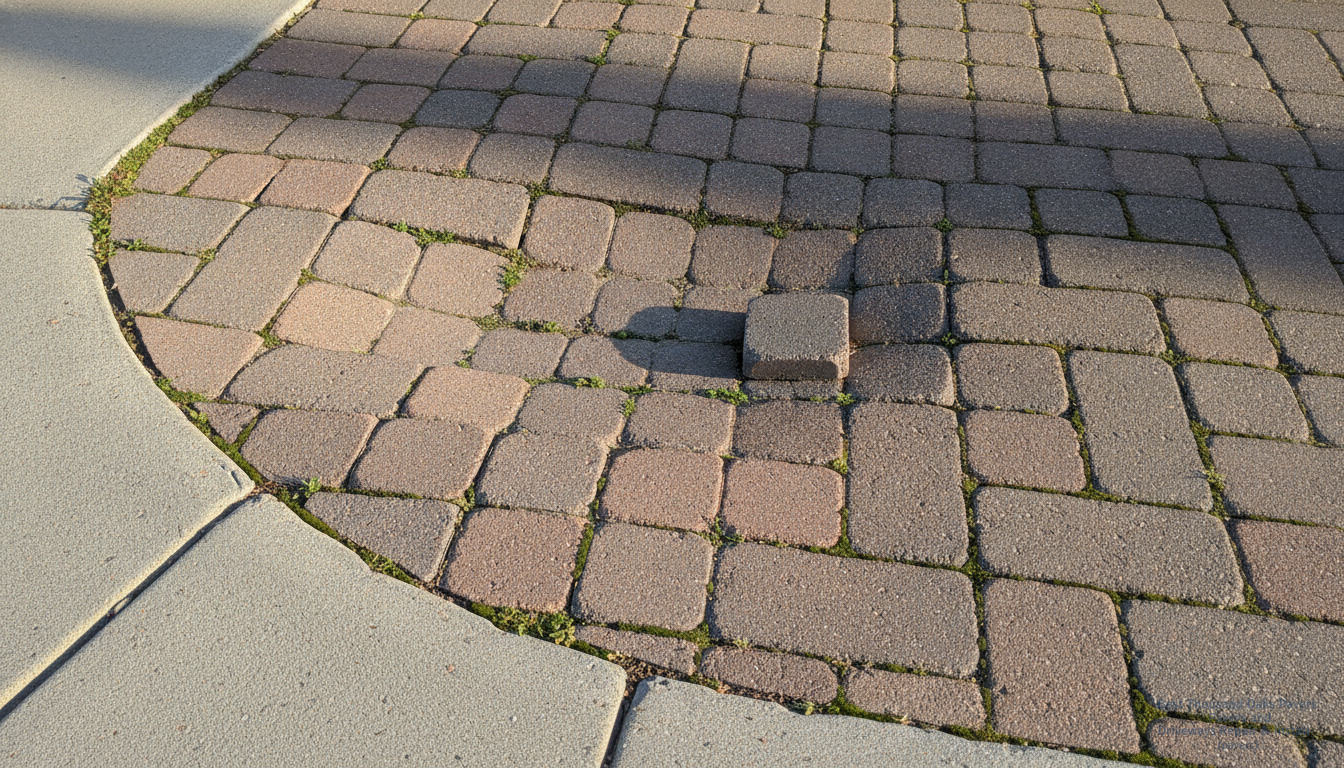
Paver driveways are built to last decades, but they're not entirely maintenance-free. The soil and drainage conditions common across the Conejo Valley — clay-heavy soils that shift seasonally, occasional heavy winter rains, and tree root activity — can gradually compromise even a well-installed driveway. The good news: paver driveways give you visible warning signs before a small problem becomes a costly one. Here are five signs it's time to call for professional paver driveway repair in Thousand Oaks.
1. Sunken or Uneven Sections
If areas of your driveway have dipped noticeably below the surrounding surface, the bedding sand or compacted base beneath those pavers has eroded or shifted. This is the most common repair issue we see throughout Thousand Oaks and in neighborhoods like Lang Ranch and Newbury Park. Left unaddressed, a sunken section will collect water after rain, accelerating the erosion cycle and causing neighboring pavers to destabilize.
The fix is not just lifting and resetting the pavers — it requires identifying why the base failed (poor drainage, inadequate compaction, or tree root intrusion) and correcting it before relaying. A surface-only fix without addressing the root cause will result in the same section sinking again within months.
2. Rocking or Wobbly Pavers
Walk across your driveway and pay attention to whether any pavers rock underfoot. A properly installed paver should be firmly bedded with no movement. Rocking indicates the sand bed beneath has washed away or the paver has lost contact with the sub-base on one edge. Beyond being a tripping hazard — an important safety concern for families in Westlake Village and Lynn Ranch — wobbly pavers allow water to infiltrate rapidly at the joint, speeding up base deterioration across a wider area.
3. Widening or Open Joints (Don't Ignore This One)
This is the warning sign most homeowners dismiss as purely cosmetic — but it's actually the most important early indicator. When the sand between your paver joints erodes away, you lose the interlock that holds the entire system together. Interlocking pavers derive their structural strength from being locked against each other through tightly filled joints. Open joints mean:
- Water is channeling directly into the base layer, washing it away with every rain.
- Weeds and grass can establish roots that physically force pavers apart.
- Ants can excavate the sand, creating voids under individual pavers.
- The driveway's load-bearing capacity is gradually reduced.
The solution is polymeric sand reapplication — a service we include as part of every driveway repair in Thousand Oaks. Polymeric sand sets firm after wetting, resisting washout and weed germination far better than standard jointing sand.
4. Cracked or Chipped Paver Edges
Edge pavers — the border units along your driveway's perimeter — take the most stress from vehicle tire loading and lateral soil pressure. Cracks and chips here often indicate either that the edge restraint system has failed or that the pavers are bearing load they weren't designed to carry without proper edge support. Cracked edge pavers should be replaced promptly because they reduce the confinement of the interior field, allowing the entire driveway to gradually spread and lose its pattern alignment.
Individual paver replacement is one of the clearest advantages pavers hold over poured concrete. Rather than patching a slab with a visibly different color of concrete, we lift and replace the specific damaged units. If your pavers are a common profile, we can often match them exactly from our supplier inventory or from regional stock available throughout the Conejo Valley.
5. Persistent Weeds and Moss Growth in Joints
Weeds and moss growing in your paver joints are a symptom, not just an annoyance. They indicate that the joint sand has largely eroded, leaving open channels where organic matter accumulates and plant seeds germinate. Moss is particularly common in shaded sections of driveways in Lake Sherwood and wooded properties throughout western Thousand Oaks. Roots from established weeds can physically displace pavers over time, and moss makes surfaces dangerously slippery when wet.
Treating this problem properly involves removing the vegetation, cleaning the joints, and reapplying polymeric sand — followed ideally by a professional paver sealing application that will inhibit future biological growth and lock the new joint sand in place.
Act Early, Save Money
All five of these warning signs share a common thread: they're far cheaper to address early than after the damage has spread. A single-day targeted repair that costs a fraction of a full replacement can add years to your driveway's life when caught in time. If you're seeing any of these signs on your Thousand Oaks driveway, don't wait until a sunken section becomes a drainage disaster or a rocking paver causes a fall.
Best Thousand Oaks Pavers and Driveways Repair & Install provides free on-site assessments and honest recommendations — we'll never recommend a full driveway installation when a targeted repair will do the job. Call us at +1 (805) 678-9753 or email [email protected] to schedule your free evaluation today. We serve homeowners throughout Thousand Oaks and the surrounding Conejo Valley seven days a week, 8:00 AM to 6:00 PM.
Questions about pavers in Thousand Oaks, CA? We're happy to help — no sales pressure.
Talk to a Local Pro
Call +18056789753 or fill out our online form for a free, no-obligation quote.
Request Free Quote